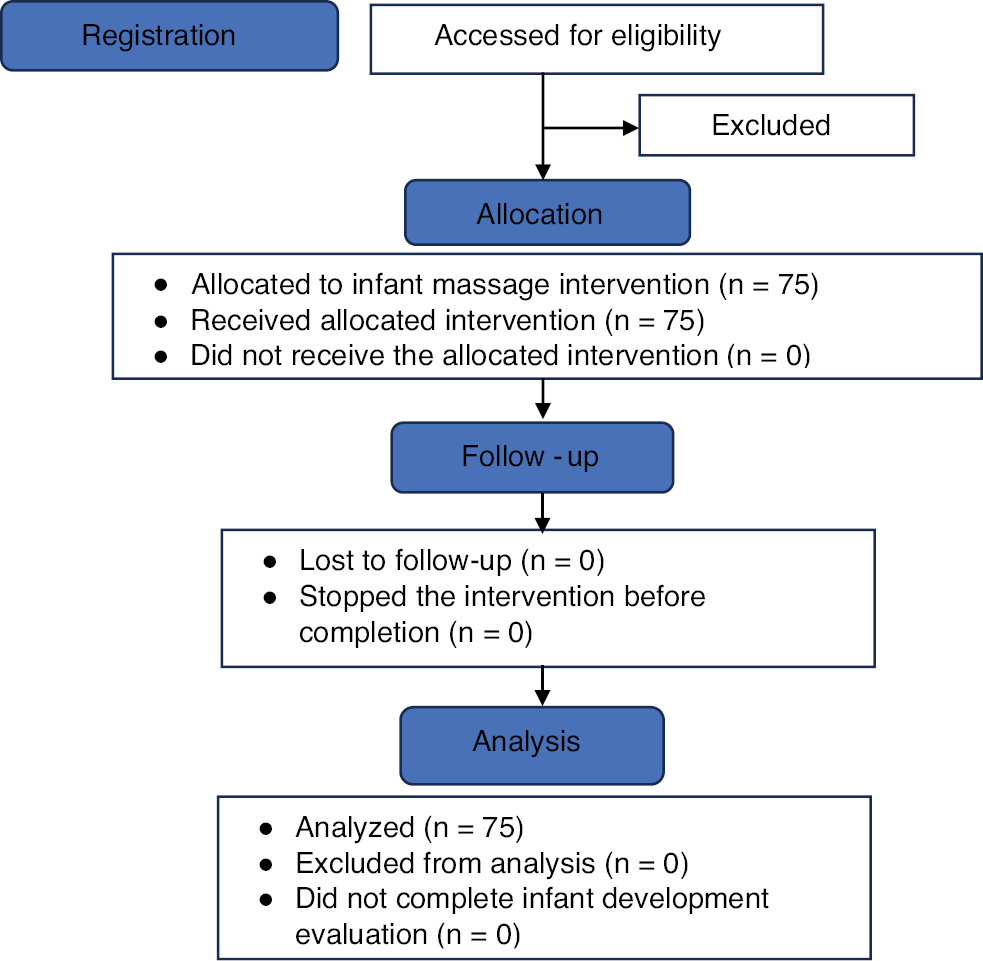
Figure 1. Study flow.
| International Journal of Therapeutic Massage and Bodywork (2026) 19(2), 7–13. | https://doi.org/10.3822/ijtmb.v19i2.1051 |
Yanti Herawati, PhD1*, Ira Kartika, S.ST., M.Keb.1, Wike Arini, S.Keb1, Lina Herlina, S.Tr.Keb., M.Keb1
1Dharma Husada College of Health Sciences, Bandung, Indonesia
Background: The initial phase of life, commonly referred to as the “golden age,” encompasses the first year, a pivotal developmental period for infants, spanning from birth to 12 months. Additionally, prenatal development of the infant warrants consideration. Massage, a gentle tactile therapy targeting specific body areas, facilitates muscle relaxation and enhances blood circulation.
Objective: This study aimed to evaluate the influence of infant massage on the development of infants aged between 1 and 3 months at Independent Midwife Practice (PMB) Wike A.
Methods: This research employed a quantitative approach, utilizing a quasi-experimental design comprising pretest and posttest phases. The research was carried out from February to March 2023, employing a purposive sampling method. The sample for the research comprised 75 infants who fulfilled the inclusion criteria. The research instruments included the Developmental Pre-Screening Questionnaire (KPSP) and the standard operating procedure for infant massage. Univariate and bivariate analyses were employed for data analysis. In the univariate analysis, the percentage frequency distribution of each distinct subvariable was examined. The Wilcoxon test was utilized for bivariate analysis.
Results: The proportion of infants with appropriate development increased from 41.3% before intervention to 61.3% after intervention. The mean developmental score increased from 7.65 to 8.75, with a mean difference of 1.06. Statistical analysis showed a significant effect of infant massage on development (p = 0.001).
Conclusion: Infant massage significantly improves the development of infants aged 1–3 months and can be recommended as an early stimulation intervention.
KEYWORDS: Infant massage; infant development; stimulation
The infancy stage is a valuable and crucial period in the growth of a child, spanning from birth to 12 months of age. Often termed the “golden age,” this phase is characterized by its brevity and irreplaceability.(1) This period is deemed critical because infants are highly sensitive to their surroundings and necessitate adequate nutrition and positive stimulation for their development.(2)
Development entails the progression of abilities, skills, and bodily functions that become more advanced and complex, encompassing gross motor skills, fine motor skills, language and speech, as well as socialization abilities and individual independence to adapt to their environment.(3) Parents can frequently discern gross motor and fine motor development in children with ease. Gross motor development encompasses movements utilizing large muscles, such as crawling, kicking, grasping, sitting, standing, and running. During infancy, developmental stages are typically categorized into age ranges of 0–3 months, 4–6 months, 7–9 months, and 10–12 months.(4)
According to the World Health Organization data, 5–25% of children under 5 years of age experience challenges with their gross and fine motor skills.(5) In Indonesia, challenges related to developmental delays are still a serious concern, although efforts to improve the quality of children have become one of the main focuses of the government.
The prevalence of developmental delay is estimated to be in the range of 12.8–16%. As many as 30% of infants experience mild delays in gross motor skills, such as the ability to turn over, which should be acquired by 3–4 months of age, but is only experienced at more than 5 months of age.(6) The percentage of children under the age of 5 years who did not have age-appropriate weight rose from 23.8% to 43.32%.(7) Globally, countries grapple with various issues concerning child development, including gross motor delays. The worldwide prevalence of gross motor delays stands at 23.5%. In the United States, it ranges from 12% to 16%, while in Thailand it is 24%. Argentina reports a rate of 22%, and Indonesia’s rate falls between 13% and 18%. According to data from the Basic Health Research (Riskesdas) in 2018, the research involved 4,902,456 children aged 1–5 years. Among these, 83.4% exhibited age-appropriate physical development.(8)
The sense of touch is established in infants as early as 10 weeks before birth. Among all the senses, touch is the first to develop prior to birth. As a result, infants exhibit a highly sensitive response to this sense of touch shortly after birth. Development and growth are ongoing processes.(3) Growth is the process of physical change and increase in body size of different individuals. Body weight and body length are the most important and commonly used anthropometric parameters in newborn growth monitoring.(9) Decreased infant appetite is one of the factors that can contribute to weight issues.(10) There are still numerous instances in the community where infants encounter suboptimal weight gain. Throughout the first year of life, if the infant receives adequate nutrition, weight gain should typically range from 140 to 200 grams per week from birth to the age of 6 months.(11)
Stimulation is one method to enhance an infant’s weight. Massage provides the advantage of stimulating sensory and motor functions, thereby aiding the infant in achieving optimal growth and development. Moreover, infant massage can boost the production of enzymes and growth hormones in cells and tissues, facilitating the optimization of infant growth and development.(3) Infant massage can increase hunger, resulting in more frequent breastfeeding, due to increased muscle tone in the vagus nerve.(11)
According to research by Gusti et al. (2023),(4) it was found that infants who received the intervention in the form of infant massage experienced minimal weight gain in accordance with the Standardized Growth Curve (KMS) chart. A total of 24 out of 52 infants studied, or about 46.15%, recorded the highest frequency in this regard. Irva’s research (2014)(12) showed that there was an increase in body weight of 700 g in a 2-week period after the provision of massage. The research conducted by Elvira et al. (2017) on the impact of infant massage on neonatal development revealed a significant improvement in development following infant massage. Consequently, it can be inferred that infant massage has the potential to optimize neonatal development.(13)
Drawing from a preliminary investigation at the midwife center in Banyusari Village, Bandung Regency, employing the Developmental Pre-Screening Questionnaire (KPSP), outcomes indicated that out of 189 infants assessed, approximately 77.8% exhibited appropriate development, 21% exhibited development that raised questions, and 1.2% exhibited developmental deviations. It was observed that mothers’ awareness regarding infant health-care practices involving stimulation, such as infant massage, remains limited. In addition, there has been no previous research examining the effect of infant massage on the development of infants aged 1–3 months at the PMB in Banyusari Village, Bandung Regency.
This research employed a quantitative approach with a quasi-experimental design, utilizing the one-group pretest–posttest method.
The research was conducted between February and March 2023. The independent variable was massage, while the dependent variable was the development of infants aged 1–3 months. The research population comprised all infants in the Banyusari Village Midwife Independent Practice area from January to February 2023, totaling 215 infants.
From the total population of infant, the researcher selected a 10% sample using the Slovin formula, resulting in a sample size of 67 infants, with an expected 10% dropout rate. Therefore, the total required sample size was 75 infants. The choice of a 10% sample size in this study was guided by practical considerations and the need to balance statistical reliability with resource constraints. Sampling 10% of the population ensures that the study remains feasible in terms of time, cost, and effort while still providing a representative subset of the population for analysis. Using the Slovin formula, which incorporates the margin of error, allows researchers to calculate an adequate sample size that aligns with their inferential goals. This percentage is particularly suitable when the population size is relatively large, as it provides sufficient data to detect meaningful differences or trends without overwhelming logistical or financial resources. Additionally, planning for a 10% dropout rate further demonstrates the researchers’ foresight in ensuring the final sample size remains statistically robust.
Inclusion criteria consisted of infants aged 1–3 months at the onset of the research, born at full term, receiving exclusive breastfeeding or formula milk, and parents willing to adhere to the entire research process and implement interventions instructed by the researcher.
Exclusion criteria consisted of infants with low birth weight and congenital abnormalities, infants who were unwell, infants who were overweight or obese, parents of respondents who do not reside permanently in the area of the midwife’s independent practice.
The infant massage intervention was conducted by trained midwives with more than 3 years of clinical experience in maternal and child health. The massage followed a standardized procedure (SOP) including gentle stroking techniques applied to the legs, abdomen, chest, arms, face, and back. Each session lasted approximately 15 min and was performed twice a week for 4 weeks. Baby oil was used as a medium to reduce friction during massage. The intervention was conducted in a quiet and comfortable environment to ensure infant relaxation.
The research instruments comprised a respondent identity sheet, the Developmental Pre-Screening Questionnaire (KPSP) for infants aged 1–3 months, and the SOP for infant massage. The identity sheet was utilized for recording respondents’ personal data, while the KPSP served as a tool for the early detection of child development, featuring 9–10 questions regarding children’s developmental capabilities. It was indicated as to when these instruments were administered (e.g., time points) and the scoring ranges/categories.
Data were collected at two time points:
The KPSP instrument consists of 9–10 items with categorical outcomes: appropriate, doubtful, and deviation.
The plan for data analysis was utilizing univariate and bivariate methods. Univariate analysis illustrates the distribution and parameters of each variable before and after treatment, whereas bivariate analysis examines the connection between two variables suspected to be related. The impact of the independent variable (infant massage) on the dependent variable (development in infants aged 1–3 months) was to be assessed using the Wilcoxon statistical test, as a substitute for the paired sample t-test due to the non-normal distribution of the research data. Normality test using Shapiro–Wilk, with a p-value > 0.05, indicates normal distribution. If the p-value < α (0.05), then H0 is rejected and H1 is accepted, indicating the effect of infant massage on infant development before and after treatment.
In this study, ethical approval has been requested and obtained from the Health Research Ethics Committee (KEPK) STIKes Dharma Husada with approval number 16/KEPK/SDHB/B/V/2023. This approval is important to ensure that all procedures carried out in this study comply with applicable ethical standards, protect the rights and welfare of participants, and ensure the scientific integrity of the results to be obtained.
The study involved 75 infants aged between 1 and 3 months, and their parents participated in providing information regarding infant development before and after the intervention. The characteristics of respondents are presented in Table 1, which shows that most infants were aged 3 months (46.7%), followed by 2 months (36.0%) and 1 month (17.3%).
Table 1. Characteristics of Respondents
| Infant’s Age | F | % |
|---|---|---|
| 1 Month | 13 | 17.3 |
| 2 Months | 27 | 36.0 |
| 3 Months | 35 | 46.7 |
| Total | 75 | 100 |
The distribution of infant development before and after the intervention is shown in Table 2. Before the massage intervention, 41.3% of infants were categorized as having appropriate development, 30.7% as doubtful, and 28.0% as having developmental deviations. After the intervention, the proportion of infants with appropriate development increased to 61.3%, while those categorized as doubtful decreased to 26.7%, and developmental deviations decreased to 12.0%.
Table 2. Frequency Distribution of Infant Development Before and After Massage
| Progress | Massage | |||
|---|---|---|---|---|
| Before | After | |||
| F | % | F | % | |
| As per | 31 | 41.3 | 46 | 61.3 |
| Doubtful | 23 | 30.7% | 20 | 26.7 |
| Deviations | 21 | 28.0 | 9 | 12.0 |
| Total | 75 | 100 | 75 | 100 |
The effect of infant massage on infant development is presented in Table 3. The mean developmental score increased from 7.65 before the intervention to 8.75 after the intervention, with a mean difference of 1.06. The results of the Wilcoxon test showed a p-value of 0.001 (p < 0.05), indicating that infant massage had a statistically significant effect on the development of infants aged 1–3 months. The study flow, including participant recruitment, allocation, follow-up, and analysis, is illustrated in Figure 1.
Figure 1. Study flow.
Table 3. Effect of Massage on the Development of Infants 1–3 Months in the Banyusari Village Midwife Independent Practice Area at PMB Wike Arini
| Progress | Mean | Mean Difference | Standard Deviation | p-Value |
|---|---|---|---|---|
| Before | 7.65 | 1.06 | 1.370 | 0.001 |
| After | 8.75 | 1.575 |
Infant massage has been the focus of significant research in recent years, especially in the context of development of infants aged 1–3 months. Research shows that massage interventions can have a positive impact on the physical and emotional development of infants. A study involving 75 infants showed that before the massage intervention, only 41.3% of the infants showed appropriate development. However, after the intervention, this proportion increased to 61.3%, indicating a significant improvement in infant development. The significance value (two-tailed) was observed to be 0.001, which is smaller than α (0.05).
The main benefits of infant massage are stimulation of the central nervous system and blood circulation.(14) Gentle touches during massage stimulate nerve endings on the skin, which send signals to the brain via the spinal cord.(15) This process increases blood and oxygen flow to the brain and the rest of the body,(16) supporting the infant’s neurological and motor development.(17) In addition, massage helps improve digestive function and increases nutrient absorption, which contributes to the infant’s significant weight gain.(18)
Massage also provides important emotional benefits.(19) During the massage process, parents can establish an emotional bond with their infant through eye contact, gentle touch, and verbal communication. According to research by Field,(20) regular massage can increase the hormone oxytocin in infants and parents, strengthening the emotional connection between them. This bond provides a sense of security for the infant and supports their psychological development.
In addition, massage has a relaxing effect that helps reduce stress in infants. The decrease in cortisol (stress hormone) levels after a massage makes infants calmer and more comfortable. This also improves infants’ sleep quality, allowing them to sleep more soundly and regularly. A bedtime massage routine is often used to help infants feel relaxed and prepare themselves for a quality night’s sleep.(20)
Another benefit of massage is the improvement of the infant’s motor skills.(21) The gentle movements during massage stimulate the small and large muscles of the infant’s body, strengthening the coordination of their movements.(22) Research shows that infants who receive regular massage have faster gross and fine motor development compared to those who do not receive massage. This is important to prepare them for the next stages of development such as sitting, crawling, and walking.
While the results of these studies are promising, the study designs often do not involve a control group. Without a control group, it is difficult to conclude that massage is the sole factor causing the improvement. Other factors such as parental attention or timing may also contribute to the observed results. Therefore, further research with more rigorous experimental designs is needed to confirm the causal relationship between massage and infant development.
Massage can also help with common health problems in infants such as colic or flatulence.(22) Gentle movements on the abdominal area can relieve such discomfort by improving digestive function.(23) In addition, stimulation through massage can boost an infant’s immune system by stimulating white blood cell production and lymph circulation.
In the context of clinical practice, it is important to educate parents on proper massage techniques so that the benefits can be maximized. Proper technique involves gentle touch on various parts of the body such as the back, abdomen, arms, legs, and face. The ideal duration for each session is about 15 min with a frequency of twice a week.
Massage also plays an important role in supporting an infant’s cognitive development.(23) Sensory stimulation through touch helps activate neural pathways in the brain that play a role in early learning such as responses to sounds or facial expressions.(22) Interaction during the massage process provides an opportunity for parents to introduce verbal communication to their infant.
In addition to the direct benefits for the infant, the practice of massage also provides advantages for the parents. It helps reduce postpartum stress in mothers by increasing the hormone oxytocin during interactions with their child. This creates a positive mood for the mother while strengthening the emotional connection between mother and child.
However, it has to be kept in mind that not all massage techniques are suitable for every infant. Parents should understand their child’s health condition before starting a massage routine. Consultation with a medical professional or pediatric massage therapist is highly recommended to ensure safety and effectiveness.
While there is preliminary evidence of the developmental benefits of massage for infants aged 1–3 months, it is important to conduct further research with better experimental designs to confirm its effectiveness. In the meantime, the practice of massage remains a potentially beneficial method of stimulation for a child’s physical, emotional, and cognitive growth.
The development of infants aged 1–3 months shows changes both before and after massage. Infant massage can provide stimulation that supports their physical, motor, and emotional development, making it an effective method to help the growth and development process in the early stages of life.
The authors would like to thank all respondents and the midwife practice for their support in this study.
The authors declare there are no conflicts of interest.
No sources of funding were used in this study.
1. Ministry of Health, Republic of Indonesia. Data and Information Center 2016. Ministry of Health; 2017.
2. Rokayah Y, Nurlatifah DL. Effectiveness of baby massage on growth and development in infants aged 5-6 months in rangkasbitung barat village in 2017. J Med (Media Inf Health). 2018;5(2):156–167.
3. Zulfiana Y, Fatmawati N, Herlina SM. Baby massage on gross motor development in infants. J Qual Public Health. 2022;5(2):774–778. [CrossRef]
4. Niky Wahyuning Gusti B DI, Pratiwi A, Sufie U, Bhakti Pertiwi Indonesia Jalan Jagakarsa Raya No Stik, Selatan J. The effect of infant massage on the weight of infants aged 1-3 months in PKT Bontang Hospital. J Ilm Kesehat BPI. 2023;7(1):81–91.
5. Soetjiningsih. Child Growth and Development. 2nd ed. Ranuh IGN. EGC; 2019.
6. United Nations Children’s Fund (UNICEF), World Health Organization, International Bank for Reconstruction and Development/The World Bank. Levels and Trends in Child Malnutrition: Key Findings of the 2020 Edition of the Joint Child Malnutrition Estimates. World Health Organization; 2020.
7. Ministry of Health, Republic of Indonesia. Stimulation, detection and early intervention of child development at the primary health care level. In: Ministry of Health, Republic of Indonesia, ed. Guidelines for the Implementation of SDIDTK. Bhakti Husada; 2016:31–59.
8. Nardina. Child Growth and Development. Yayasan Kita Tulis; 2021.
9. Riskesdas. Ministry of Health Research and Development. Basic Health Research; 2018.
10. Astriana A, Suryani IL. The effect of infant massage on weight gain in infants at BPS Masnoni in North Betung Bay, Bandar Lampung City. Holistic J Kesehat. 2017;11(2):72–76.
11. Purba SJA, Wilar R, Gunawan S. Anthropometric status of infants admitted to the neonatal intensive care unit of RSUP Prof. Dr. R. D. Kandou Manado. J Med Rehabil. 2019;1(3).
12. Irva, Tri Sasmi et al. The effect of massage therapy on infant weight gain. J Indonesian Nutrition Assoc. 2014.
13. Elvira M, Azizah S. Infant massage on weight gain of infants aged 0-6, at BPS Bunda Bukittinggi B, Padang Panjang Jl Kamarullah No AH, Surungan Padang Panjang B. Jurnal Pembangunan Nagari. 2017:2(1):85.
14. Febriyanti SNU, Munjilah W, Adinatha NNM, Hudhariani RN. The effect of baby massage toward the development of three months baby. In: 1st Borobudur International Symposium on Humanities, Economics and Social Sciences (BIS-HESS 2019). Atlantis Press; 2020:713–716.
15. Mrljak R, Arnsteg Danielsson A, Hedov G, Garmy P. Effects of infant massage: a systematic review. Int J Environ Res Public Health. 2022;19(11):6378. [CrossRef] [PubMed]
16. Sari WP. Identification of growth and development of children with delayed walking and age-matched comparison children in the age range of 12-18 months. JPP PAUD FKIP Untirta. 2022;9(1):85–95.
17. Rohmah S. The effectiveness of baby massage on physical, mental, and motor development, as well as mother-baby interaction. 2th Int Conf Heal Sci. 2024;15(1):37–48.
18. Tanaka Y, Watanabe H. Effects of one-month baby massage by mothers on autonomic nervous system function and growth development of 4- and 5-month-old infants. Women Midwives Midwifery. 2023;3(3):56–69. [CrossRef]
19. Kamiya C, Miyake A, Yamada T, Ohmi M, Watanabe H. The effects of massage velocity on heart rate and heart rate variability in healthy infants: a randomized crossover study. Infant Behav Dev. 2021;64:101604. [CrossRef] [PubMed]
20. Field T. Massage therapy for infants and children. J Dev Behav Pediatr. 1995;16(2):105–111. [CrossRef] [PubMed]
21. Rahmawati SY, Rukmaini, Novelia S. The effect of baby massage on body weight and sleep quality of babies aged 3-6 months. Heal Technol J. 2024;2(2):150–156. [CrossRef]
22. Rayhani S, Mochtar NM, Djalilah GN, Asmarani RI. Well-being of infants through touch: the effects of massage on sleep quality and weight gain in the first 0-12 months. Golden Age J Ilm Tumbuh Kembang Anak Usia Dini. 2024;9(2):357–374. [CrossRef]
23. Afrida HK, Ardiansyah J. Effectiveness of baby massage on motor development in babies: literature review. Int J Soc Res. 2024;2(2):79–86. [CrossRef]
Corresponding author: Yanti Herawati, Master’s Program in Midwifery, Dharma Husada College of Health Sciences, Jl. Terusan Jakarta No. 75, Cicaheum, Kiaracondong, Bandung, West Java 40282, Indonesia. E-mail: yantiherawati@stikesdhb.ac.id Tel: +62-821-1993-8623
COPYRIGHT
Published under the CreativeCommonsAttribution-NonCommercial-NoDerivs3.0License.
International Journal of Therapeutic Massage and Bodywork, Volume 19, Number 2, June 2026